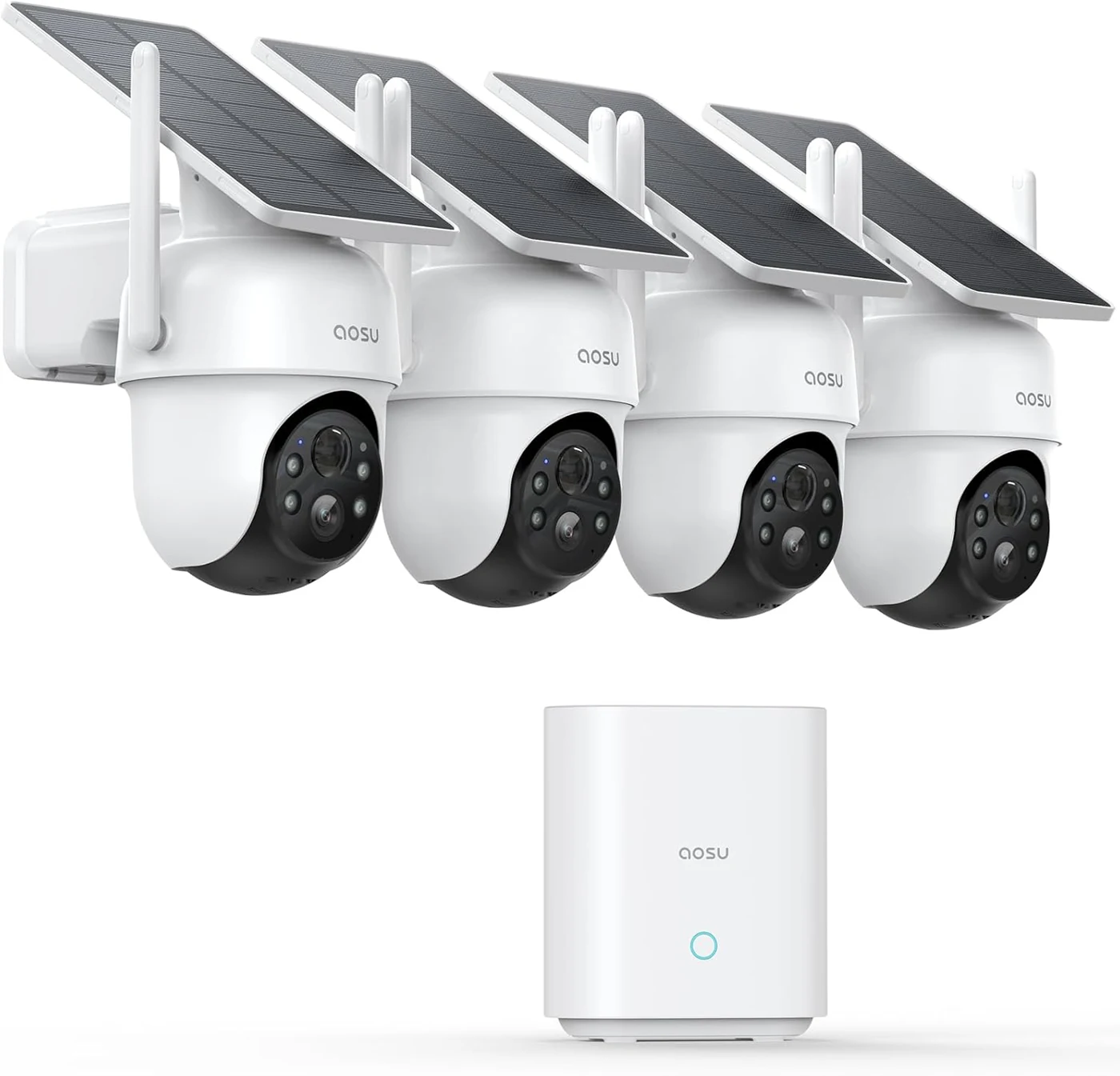
Our verdict: buy it for easier installation, not complete incident coverage
The strongest reason to choose this kit is practical: you can place cameras around an existing home without bringing an electrical outlet or Ethernet cable to every position. The indoor base collects recordings away from the cameras, and you do not have to buy a cloud plan just to keep the included local event clips.
That convenience has a cost that a subscription comparison misses. Battery cameras depend on detecting an event before recording it. A system that saves money but fails to capture the part of an event you need is the wrong purchase. Our recommendation is conditional: shortlist the D1 Classic for everyday activity awareness; choose a continuously recording system when reconstructing the whole sequence matters more than installation effort.
What makes it attractive
- Four camera positions in one purchase, managed through one app.
- Integrated solar panels avoid separate panel cables at each mount.
- Included base storage keeps clips indoors rather than only on an exposed camera.
- Pan, tilt and linked event review can help follow activity across monitored zones.
What would make us pass
- No continuous 24/7 timeline or promise that every approach will be captured.
- Camera position must suit both the view and the integrated panel's sunlight needs.
- The powered, Ethernet-connected base remains part of the installation.
- 32GB storage and a four-camera first-generation base leave limited expansion headroom.
Which D1 Classic kit does this review cover?
The selected US Amazon listing is the D1 Classic 4-Cam Kit with first-generation aosuBase, not an individual C9C camera, a six-camera aosuBase 2.0 package, or an aosuCortex system. Sharing a D1 name does not make their storage and expansion features interchangeable.
| Item | Selected bundle | Buying implication |
|---|---|---|
| US product identity | ASIN B0CNRDG796; four cameras | Match the selected variation and included base before ordering. |
| Video and movement | 2K (3MP); pan, tilt and automatic tracking | Movement changes the view; it does not show every direction simultaneously. |
| Local recording | 32GB built into first-generation aosuBase; motion events | Do not assume continuous recording or newer-base storage upgrades. |
| Power and network | Solar/battery cameras; powered base connected to router LAN by Ethernet | Outdoor cameras are wire-free, but the complete system is not off-grid. |
| Viewing | Up to four live feeds in the aosu app; no base HDMI/TV output | Not a direct-to-monitor surveillance package. |
These are published bundle specifications checked October 21, 2026, not measurements from our own sample. The aosu solar-camera overview provides a shorter introduction if you are still deciding between a kit and other brand options.
Will it capture the whole event?
Do not buy this kit on the assumption that it will. aosu documents motion-triggered recording, rather than continuous video. That distinction matters more than whether a saved clip looks sharp: anything outside the recorded event is unavailable to review later.
Consider a driveway dispute. You may need to know what happened before a person entered the detection area, not simply see them leaving. For a general check on deliveries or activity beside a gate, a useful event clip may be enough. For a disputed vehicle movement or a fast incident, an uninterrupted recording timeline is the safer system requirement.
Auto-tracking and Cross-Camera Tracking solve different problems. The first moves a camera's view; the second groups related clips from cameras that detected activity. Neither fills in an unrecorded period. A camera looking down a side path also cannot simultaneously watch everything behind it merely because its mechanism can turn through 360 degrees.
Our placement advice: use the four positions to cover approaches, not just four attractive wide views. Leave a critical entrance in the default view and use another camera for a competing direction. If no arrangement provides the evidence you need, change the recording architecture rather than expecting tracking to repair the gap.
Is the 2K night vision enough?
Enough to observe activity is not the same as enough to identify someone. The listing offers infrared night vision and spotlight-assisted color video. We have not verified face recognition distance, moving-person detail, or readable license plates with this kit, so we would not recommend it for those requirements on resolution alone.
For a porch or a narrow gate, ask whether the saved clip shows a moving person's face at the point where identification matters. For a driveway, a wide view may show that a car arrived without preserving the plate. Digital zoom does not guarantee that the missing detail is there.
Compare the same walk in infrared and spotlight modes during your return window. Judge exported moving footage, not a still image or the live preview. Also check whether the light shines into a neighbor's window. If nighttime identification is essential, choose placement, lighting and camera hardware around that requirement rather than treating color night vision as proof of it.
Does solar mean you will never recharge it?
No; plan for access to every camera. An integrated panel makes the installation tidier, but ties the useful camera angle to a location with useful sunlight. A good view under a deep eave may be a poor place to collect solar energy.
The relevant question is not whether the camera gets some sun in summer. It is whether its charging can keep pace with activity through your least favorable season. A quiet backyard and a driveway facing frequent traffic are different workloads. Live viewing, tracking and spotlight use also belong in that energy budget.
In its hands-on C9C-4H review, Mighty Gadget reported differing battery outcomes between placements and noted the integrated panel's positioning constraint. That older, manufacturer-supplied review sample is useful context, not a battery forecast for this US ASIN or your climate.
Our buying rule is simple: if the only secure mounting point is shaded and needs a ladder for charging, the wire-free advantage becomes less convincing. Consider a system with separately positionable panels or wired power. Do not reduce necessary event capture just to preserve an attractive battery percentage.
What does no subscription actually save?
The benefit is usable included local event storage, not unlimited storage or zero ownership cost. With this base, a camera being removed does not by itself remove the recordings already stored indoors. But a single base is still a single copy; local recording is not the same thing as an off-site backup.
We would not use a fixed retention promise to choose this bundle. The Amazon listing mentions about 120 days, while aosu's current FAQ distinguishes an estimate of up to 60 days for four cameras from up to 120 for two. Event frequency, clip length and settings change the result. Neither figure means that many days of continuous video.
Export important clips before they are overwritten. If protection against losing the base matters, check optional cloud coverage, current pricing and supported functions separately. Do not assume that paying for cloud storage turns the camera into a continuous recorder.
For a fair cost comparison, use the full four-position basket: the kit, any mounting work, your time recharging difficult positions, and any optional backup plan. Compare that with a wired alternative including cabling and storage. No monthly cloud bill is valuable, but it should not outweigh a mismatch between the footage available and the footage you need.
How dependent is it on the base and the app?
Wireless describes the camera-to-base link, not an absence of infrastructure. Put the base somewhere with power, an Ethernet path to the router and a usable wireless connection to all four camera positions. Testing a phone's home Wi-Fi alone does not establish that the camera-to-base link will work.
aosu says local events can continue during an internet outage if cameras and base stay powered and connected to each other. Remote viewing and alerts need internet service. Losing base power is a different failure; the outdoor batteries do not keep the indoor base running.
The app is also part of the purchase: opening a live view, finding the correct event and exporting it all matter. We have not measured current app latency or reliability on this bundle. Test those tasks from a phone on cellular data, not only while standing beside the router.
For a detached garage, metal outbuilding or remote gate, check the connection at the exact mounting position before drilling. If the property has no broadband connection or base power, read our remote-property camera guide instead; this is not a cellular kit.
When is another type of camera the better buy?
| Your priority | Our preferred path | What you give up |
|---|---|---|
| Four sunny outdoor positions; event awareness; little new wiring | D1 Classic is a sensible shortlist candidate. | Continuous coverage and freedom from battery upkeep. |
| Complete incident timeline at a busy entrance | A continuously powered camera and recorder explicitly supporting 24/7 recording. | The simpler wire-free installation. |
| Only one or two positions | A smaller kit or a standalone camera with suitable local storage. | The convenience of four included views; avoid paying for unused positions. |
| Remote site without broadband | A cellular system with compatible coverage and a data plan. | The simplicity of using existing home internet; mobile data adds cost. |
| More than four cameras or future storage expansion | Choose a base/recorder architecture with confirmed capacity before buying cameras. | A potentially lower entry price for this fixed four-camera package. |
For a wired expansion path, our Reolink NVR comparison separates recorder capacity from ports and included storage. For the wider choice of recording locations and recurring fees, use our local-storage security camera guide. These are architecture alternatives, not claims that we ran a head-to-head image-quality test.
What would we check during the return window?
This is a recommended acceptance check for your installation, not a test we have already performed. Save the clips so you can judge results rather than rely on notifications.
- Check the approach: walk toward and across each intended view in daylight. Inspect whether the saved clip begins early enough and covers the required route.
- Repeat after dark: compare a moving subject in infrared and spotlight modes. Evaluate the details you actually need to see.
- Check competing activity: have movement occur in two relevant directions. Confirm which areas remain visible while a camera tracks.
- Check retrieval: open an event, compare the relevant cameras and export a clip while your phone uses cellular data.
- Track upkeep: record battery trends through normal activity and poor weather. Confirm that each camera is safely accessible for charging.
Before ordering, confirm the four-camera variation, first-generation base, seller, included mounts and power accessories, and the return terms shown for that offer. A direct-store promotion is not automatically an Amazon order's policy.
How we reached this verdict
We matched the US ASIN and product imagery, compared the Amazon bundle description with current manufacturer guidance, and reviewed earlier D1 Classic coverage for issues worth checking. Our assessment prioritizes recording completeness, installation constraints and ownership effort over a feature count. We exclude standalone-camera storage claims and newer-base expansion features from this bundle.
We have not independently measured detection success, alert delay, night identification, solar endurance, wireless range, encryption security or long-term durability. We therefore do not award a numerical test score or describe the product image as our own sample. The recommendation is a buying judgment based on documented capabilities and their practical tradeoffs, not a substitute for an installation-specific test.
Frequently asked questions
Is the aosu D1 Classic 4-Cam Kit worth buying?
It is worth shortlisting for four outdoor positions with useful sunlight, an internet-connected powered base and a need for motion clips. Choose another architecture if continuous recording, difficult shaded mounting or more than four cameras is the main requirement.
Does the D1 Classic record continuously?
No. This kit records motion-triggered events. Auto-tracking and Cross-Camera Tracking do not create a continuous 24/7 timeline.
Do I need a subscription or a memory card?
The selected kit includes 32GB of local storage in aosuBase, so a cloud subscription or separate memory card is not required for that included local recording. Optional cloud services and other bundle variants have different conditions.
Can it work without internet?
aosu says local events can continue if the cameras and base remain powered and connected to each other. Remote live view, playback and alerts require internet. This does not mean the base keeps recording without power.
Can I use it at a gate with no Wi-Fi or power?
Not as a self-contained cellular system. The base needs power and an Ethernet connection to a router for normal remote use, and the gate camera needs a usable wireless connection to that base.
Is this the aosuBase 2.0 or aosuCortex bundle?
No. This review covers US ASIN B0CNRDG796 with a first-generation aosuBase and four cameras. Do not assume the camera limits, storage expansion or advanced features of newer base variants apply.
The bottom line
Buy for the installation you can realistically maintain, and the kind of recording you actually need. The D1 Classic can make a four-position outdoor system practical without a compulsory cloud plan. We would compare it seriously for a suitable home, but not use solar charging, 360-degree movement or a low running cost to excuse an incomplete recording strategy.
Need a different bundle? Compare aosu options in the Amazon store.